What Is a Stellium in Astrology? A Careful Definition
- A Stellium Is a Concentration, but the Threshold Varies
- The Definition We Use Here
- Why Astrologers Disagree
- How to Find a Stellium in Your Birth Chart
- Sign Stellium vs. House Stellium
- How to Read a Stellium Without Flattening It
- What a Stellium Does Not Mean
- A Worked Reading Framework
- Why Stelliums Feel So Convincing
- The Bottom Line
A Stellium Is a Concentration, but the Threshold Varies
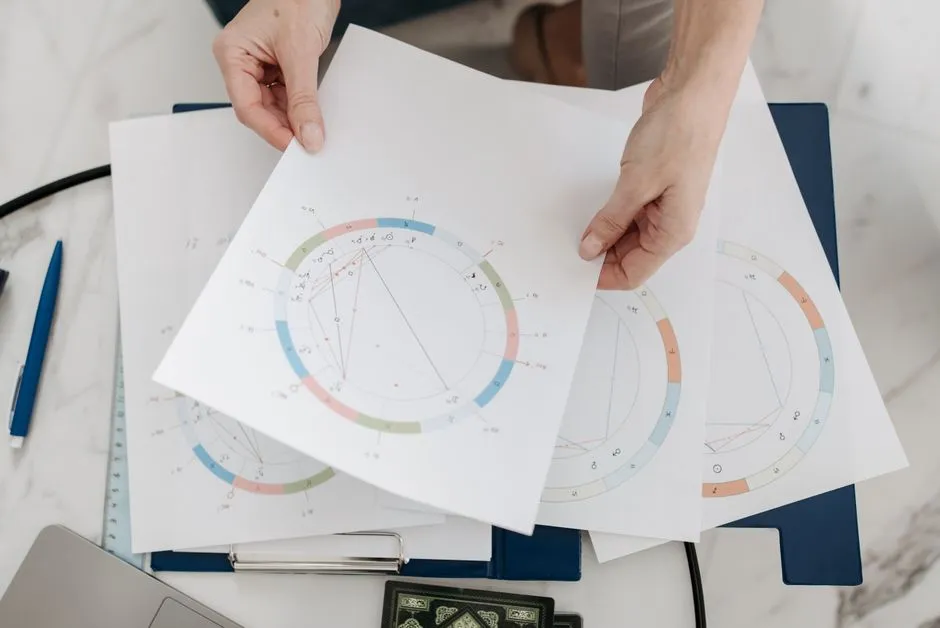
A stellium in astrology is a cluster of planets in one zodiac sign, one house, or both. A common modern working definition is three or more planets, while stricter astrologers require four or require the planets to form a close chain of conjunctions. Because there is no universal definition, state the rule you are using before deciding whether a chart has one.
The interpretive idea is simpler than the terminology dispute: several planetary symbols are concentrated in one style of expression or area of life. Astrologers read that part of the chart as emphasized. Emphasized does not mean blessed, cursed, rare, dominant in every situation, or capable of predicting an outcome.
The Definition We Use Here
For a clear first pass, we use:
Three or more of the ten standard astrological planets or luminaries in the same sign or the same house, followed by a check of their degrees to see whether they are actually close.
In common natal-chart language, the “ten” are the Sun, Moon, Mercury, Venus, Mars, Jupiter, Saturn, Uranus, Neptune, and Pluto. Astronomy classifies the Sun as a star, the Moon as a natural satellite, and Pluto as a dwarf planet; astrology traditionally groups them as chart bodies for interpretation. That is vocabulary, not an astronomical reclassification.
We do not count the Ascendant, Midheaven, lunar nodes, Chiron, asteroids, or calculated points toward the minimum. They can modify a cluster, but calling every symbol a planet makes the definition impossible to compare. If another astrologer uses a different rule, neither chart has changed—only the label has.
Why Astrologers Disagree
There are four separate questions hidden inside “Do I have a stellium?”
Three planets or four?
Three is a common contemporary threshold. Four creates a stricter and less frequent category. Rather than declaring either one official, report the count: “I have three planets in Virgo” communicates more than arguing over terminology.
Same sign or same house?
A sign stellium groups planets by zodiac sign. A house stellium groups them by house. Those are different claims.
Three planets can share Capricorn while falling into two houses. Three planets can share the sixth house while straddling two signs. The sign describes a common symbolic style; the house describes a common area of life. When both sign and house match, the concentration is easier to describe, but it is not automatically “more powerful” in any measurable sense.
Must the planets be conjunct?
Sharing a 30-degree sign does not guarantee a tight conjunction. Planets near opposite ends of the same sign may be far apart by degree even though a chart app colors them alike.
Some astrologers use “stellium” for sign or house membership alone. Others require the planets to be close enough that each connects by conjunction to the next. The careful approach is to state both facts: membership and degree span.
Which bodies count?
Some methods include the Sun and Moon freely. Some want at least one or two personal planets—Sun, Moon, Mercury, Venus, or Mars—before reading the cluster as strongly personal. Some discount a cluster made only of slow outer planets because many people born in the same period share it.
Again, describe before ranking. “Uranus, Neptune, and Pluto occupy the same house” is useful information even if your chosen method does not call it a stellium.
How to Find a Stellium in Your Birth Chart
Step 1: Generate a chart with degrees and houses
Use accurate birth date, time, and place. Sign positions can often be found from date alone, but houses depend on time and location. If birth time is unknown, do not make a confident house-stellium claim.
Our birth-chart reading guide walks through the wheel and symbol list. Choose one house system for the first analysis and name it, because a planet near a cusp can change houses when the system changes.
Step 2: Make a planet list
Write each of the ten bodies with sign, exact degree, and house:
| Body | Sign and degree | House |
|---|---|---|
| Sun | ||
| Moon | ||
| Mercury | ||
| Venus | ||
| Mars | ||
| Jupiter | ||
| Saturn | ||
| Uranus | ||
| Neptune | ||
| Pluto |
Do not add the Ascendant or node to reach three. Keep those on a separate list of nearby points.
Step 3: Count by sign
Group the planet list under Aries through Pisces. Any sign with three or more meets our broad sign-based definition. Record the actual bodies and their degree span.
Step 4: Count by house
Group the same planets under houses one through twelve. Any house with three or more meets our broad house-based definition. Recheck the birth time and house system before interpreting it.
Step 5: Inspect degree distance
Put the cluster in degree order. Are all planets genuinely close, or does one sit far from the others? Are there direct conjunctions, or merely shared membership? Use the aspect settings of the system you follow and report them instead of inventing one universal orb.
Step 6: Note personal and outer planets
A Sun-Mercury-Venus cluster is interpreted differently from Uranus-Neptune-Pluto. The first is built from personal symbols; the second may describe a broad cohort before it says anything individual. A slow-planet cluster becomes more personally specific in astrology when it closely connects with a personal planet or chart angle—but that remains symbolic interpretation.
Sign Stellium vs. House Stellium
| Feature | Sign stellium | House stellium |
|---|---|---|
| Groups by | Zodiac sign | Astrological house |
| Birth time needed | Not always for the sign list | Yes for dependable houses |
| Main interpretive question | How does the cluster express? | Where does the cluster concentrate? |
| Can cross the other system? | Yes, one sign may span houses | Yes, one house may contain parts of signs |
| Sensitive to house system | No | Yes |
Suppose Mercury, Venus, and Mars are all in Gemini. That is a Gemini sign cluster: astrologers would read a shared emphasis on Gemini-style curiosity, language, exchange, or adaptability. If two are in the ninth house and one is in the tenth, it is not also a three-planet house cluster.
Now suppose the same three planets occupy the tenth house but Mercury is late Taurus while Venus and Mars are early Gemini. That is a house cluster focused on tenth-house topics, not a one-sign stellium.
How to Read a Stellium Without Flattening It
1. Start with the individual planets
List what each body symbolizes in the astrological system you use. Mercury is not Venus, and Venus is not Saturn merely because they share a room. Our planet meanings guide provides the basic roles.
Ask which planet is easiest to express, which introduces restraint or pressure, and which broadens the theme. Do not reduce the cluster to one adjective.
2. Read the sign as the shared style
The sign provides element, modality, ruler, and characteristic mode. A Virgo cluster is commonly read through mutable earth: analysis, practical adjustment, craft, sorting, service, and discernment. That does not make every planet “a Virgo personality.” It gives several functions a similar operating style.
3. Read the house as the shared arena
The house points to life topics. A sixth-house concentration is traditionally associated with routine, labor, skill, service, and maintenance; a tenth-house concentration with public role, reputation, direction, and authority.
House meanings are symbolic categories, not instructions. A sixth-house cluster does not diagnose illness. A second-house cluster does not predict wealth. A seventh-house cluster does not order anyone to marry.
If house vocabulary is new, use our 12-house explainer before interpreting the cluster.
4. Follow the dispositor
The planet ruling the stellium's sign is often used as a routing clue. For a Gemini cluster, astrologers look to Mercury's sign, house, and aspects. For a Capricorn cluster, they look to Saturn.
This does not make the ruler a boss issuing commands. It shows where the chart's symbolic chain leads next and prevents the analysis from becoming a closed loop.
5. Read close aspects inside and outside the cluster
Identify actual conjunctions among cluster planets, then note strong aspects from planets elsewhere. An outside square, trine, or opposition can become part of how the concentration is expressed. The rest of the chart remains relevant.
What a Stellium Does Not Mean
It does not mean you “are” one sign
Even four planets in one sign do not erase the Sun, Moon, Ascendant, houses, aspects, or remaining planets. Concentration is not totality.
It does not make empty houses bad
Every natal chart has twelve houses and a limited number of planets, so many houses will be empty. Their topics still exist and are interpreted through the sign on the house and its ruler.
It does not guarantee talent or difficulty
A cluster can be read as focus, repetition, tension, fluency, overinvestment, or a mixture. No arrangement guarantees success, trauma, fame, wealth, or a calling.
It does not make a chart rare without calculation
Do not call a configuration statistically rare unless you have defined the bodies, threshold, orb, zodiac, house system, population, and calculation method. “I have never seen one like this” is an anecdote, not a frequency study.
It does not override agency
Astrology is not a medical, legal, financial, or relationship decision system. A chart pattern cannot tell you to leave a job, invest money, accept harm, or ignore professional advice.
A Worked Reading Framework
Imagine a chart with Mercury, Venus, and Mars in Libra, all in the fourth house, with the degrees close enough to form a chain of conjunctions under the astrologer's chosen orbs.
Read it in layers:
- Planets: communication, value/affection, and assertion are grouped.
- Sign: Libra supplies a cardinal-air style concerned with relating, balance, aesthetics, and negotiation.
- House: the fourth locates the symbolism around home, roots, privacy, and foundations.
- Ruler: Venus rules Libra, so Venus's condition inside the cluster receives attention.
- Aspects: outside connections show where support or friction enters.
- Reality check: ask whether this language describes a recognizable pattern rather than declaring that it must.
A reflective reading might ask: “How do I negotiate competing needs at home?” It would not announce: “You will have family conflict.” The first is an invitation; the second is unsupported certainty.
Why Stelliums Feel So Convincing
A cluster gives a reader several symbols that can be organized around one theme. That coherence can feel striking, especially when the sign and house tell a similar story.
Coherence can also encourage confirmation bias: once “intense tenth-house person” becomes the headline, evidence that supports it stands out and contrary evidence becomes footnotes. Keep interpretations falsifiable enough to be useful. Write down what the placement supposedly describes, then notice both matches and misses.
Our article on the evidence for astrology separates astronomy, symbolic practice, psychology, and prediction. A stellium can be a productive organizing metaphor without becoming scientific proof or a forecast.
The Bottom Line
Use three planets as a broad working threshold, state whether you mean sign, house, or close conjunction cluster, and report the planets and degrees. Then read the individual bodies, shared sign, shared house, ruler, and outside aspects in that order.
The label should make a chart easier to discuss. If deciding whether the cluster officially “counts” becomes more important than understanding what is actually grouped, the vocabulary has swallowed the reading.