How to Read Your Birth Chart: A Step-by-Step Guide
- How to Read Your Birth Chart, Step by Step
- Step 1: Generate an Accurate Chart
- Step 2: Read the Big Three First
- Step 3: Understand the Wheel's Structure
- Step 4: Combine Sign, House, and Planet
- Step 5: Read the Aspects
- Step 6: Look for Patterns and Emphasis
- A Simple Reading Order to Follow
- Common Beginner Mistakes
- The Bottom Line
How to Read Your Birth Chart, Step by Step
To read your birth chart, work through it in four passes: find your Sun, Moon, and rising signs (the big three), then read each planet by its sign (how it acts), then by its house (where it plays out), and finally the aspects (how planets talk to each other). Start with the big three, add one layer at a time, and resist the urge to interpret every symbol at once. A chart is a story, and you read it the way you read any story: main characters first, subplots later.
That order matters. Most people open a natal chart, see a wheel crammed with a dozen glyphs and crisscrossing lines, and quietly close the tab. The wheel isn't hard once you know it's just three questions stacked on top of each other: what energy, expressed how, and in what area of life. This guide walks you through generating the chart, decoding the wheel, and building a real interpretation without needing an astrologer.
Step 1: Generate an Accurate Chart
You can't read a chart you haven't calculated correctly, and the single biggest source of error is birth time.
You need three pieces of data:
- Date of birth — sets the Sun and most planetary positions.
- Exact time of birth — sets the rising sign and the house cusps. Off by a few hours and your entire house structure shifts.
- Place of birth — city and country, which anchor the chart to a specific horizon.
Find your birth time on your birth certificate (the long-form version, not the short card), a baby book, or by asking a parent. If you truly can't find it, you can still read a "solar chart" that skips the rising sign and houses, but expect it to feel roughly 60 to 70 percent complete. The rising sign and houses are where a lot of the personal texture lives.
One practical note: if your birth time is recorded to the nearest hour or you only have a rough estimate, treat the rising sign and house cusps as provisional. A placement sitting near the edge of a house could actually belong to the next one over. When a reading feels slightly off, an uncertain birth time is usually the culprit rather than the astrology itself.
Plenty of free calculators generate an accurate wheel in seconds, and a professional reading is optional rather than required. If you're weighing whether to pay someone, our breakdown of what a natal chart reading typically costs covers realistic price ranges and free alternatives. For the mechanics of what the chart actually is before you interpret it, see our plain-English explainer on what a birth chart contains.
Step 2: Read the Big Three First
Before you touch anything else, locate your Sun, Moon, and rising signs. These three placements carry the most weight in most readings, and they give you a frame for everything that follows.
| Placement | What it governs | Quick prompt |
|---|---|---|
| Sun | Core identity, ego, what energizes you | "Who I am when I'm being most myself" |
| Moon | Emotions, instincts, what you need to feel safe | "How I process feelings in private" |
| Rising (Ascendant) | First impressions, outward style, how you meet the world | "The version of me people meet first" |
The Sun is easy; it's your familiar "star sign." The Moon and rising are where people usually discover why they never felt much like their Sun sign. A Capricorn Sun with a Pisces Moon and Gemini rising is a genuinely different creature than a Capricorn through and through. Spend real time here. Our full guide to the big three placements goes deeper on reading them as a trio rather than three separate labels.
Step 3: Understand the Wheel's Structure
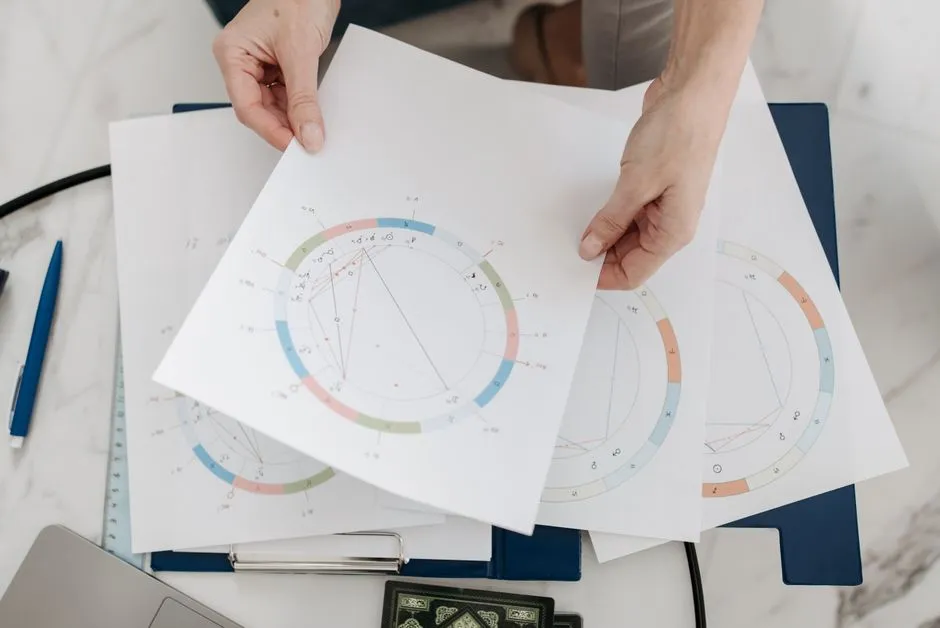
The circular chart is a snapshot of the sky flattened onto a wheel. Four elements make it up, and you read all four together.
The Signs (the outer ring)
The twelve zodiac signs sit around the rim, each occupying a 30-degree slice. A sign describes the style or flavor of a planet's energy — Mars in patient Taurus expresses very differently from Mars in impulsive Aries.
The Planets (the glyphs inside)
The planets are the actors. Each one governs a domain of life: Venus handles love and values, Mercury handles thinking and speech, Mars handles drive and anger, and so on. Where a planet lands tells you how that specific function operates in you. Our reference on what each planet means is worth keeping open as a cheat sheet.
The Houses (the 12 numbered wedges)
The wheel is sliced into twelve numbered sections called houses, and they represent areas of life — money, relationships, career, home. A planet's house tells you the arena where its energy shows up. Venus in the 10th house points love and charm toward career and public life; Venus in the 4th points it toward home and family. Our guide to the twelve astrological houses covers what each one rules.
The Aspects (the lines across the center)
Those colored lines connecting planets are aspects: the geometric angles between them. They describe how two planets get along — easily or with tension.
Step 4: Combine Sign, House, and Planet
This is the move that turns a chart from a list of facts into a reading. For each placement, chain three questions together:
- What is the planet? (the function — e.g., Mercury = how you think and communicate)
- What sign is it in? (the style — e.g., Scorpio = intense, probing, private)
- What house is it in? (the arena — e.g., 9th house = beliefs, travel, higher learning)
Read as a sentence: "Mercury in Scorpio in the 9th house" becomes "I think in deep, investigative ways, and I direct that mental intensity toward big questions, philosophy, and learning." That's it. Every placement in the chart follows the same formula. Work through the planets one at a time and jot a one-line sentence for each.
Start with the personal planets — Sun, Moon, Mercury, Venus, Mars. They change quickly and describe you personally. The social and outer planets (Jupiter, Saturn, Uranus, Neptune, Pluto) move slowly and color whole generations, so read them mostly by house and aspect rather than treating the sign as deeply personal.
Step 5: Read the Aspects
Aspects are the relationships between planets, and they explain the internal push-and-pull people feel. You don't need all of them at first; focus on the major five.
| Aspect | Angle | Feel | What it means |
|---|---|---|---|
| Conjunction | 0° | Blended | Two planets fused; their energies merge and amplify |
| Sextile | 60° | Easy | Cooperative, an opportunity you have to act on |
| Square | 90° | Friction | Tension that drives growth; the chart's "homework" |
| Trine | 120° | Flowing | Natural talent, often so easy you take it for granted |
| Opposition | 180° | Push-pull | Two forces seeking balance, often projected onto others |
A quick way in: find the squares and oppositions first. Those tension aspects tend to describe the recurring challenges and the most interesting parts of a personality. Trines and sextiles describe where life comes easier. A chart with lots of squares isn't a "bad" chart; it's usually a driven one, because friction is what pushes a person to develop.
You don't have to map every line at once. Start with aspects to your Sun, Moon, and rising ruler, since those touch the most personal parts of the chart. The aspects between two slow outer planets often matter less for you individually, because millions of people born the same year share them.
Watch the orb. An aspect is tightest and strongest when the angle is exact. Astrologers allow a margin of a few degrees (the "orb"); the closer to exact, the more it matters. Wide aspects are faint background music.
Step 6: Look for Patterns and Emphasis
Once individual placements make sense, zoom out and read the chart as a whole.
- Stelliums — three or more planets clustered in one sign or house. This is a spotlight; that sign or life area dominates the person.
- Element balance — count how many planets fall in fire, earth, air, and water. A chart heavy in water and light in earth suggests a deeply feeling person who may struggle with practical grounding.
- Chart shape — are the planets spread evenly around the wheel, or bunched in one section? A tight cluster points to a focused, specialized life; an even spread suggests broad range.
- The chart ruler — the planet that rules your rising sign gets extra weight. Find it, note its sign and house, and treat it as a lead character.
- Empty houses — totally normal and not a deficiency. An empty house just means that life area is run by its sign and ruling planet rather than a resident planet. You only have ten planets and twelve houses, so at least two are always empty.
A Simple Reading Order to Follow
If you want a repeatable routine, read your chart in this sequence every time:
- Rising sign — the lens the whole chart looks through.
- Sun — core identity and its house.
- Moon — emotional needs and its house.
- Chart ruler — where your ascendant's ruler lands.
- Personal planets — Mercury, Venus, Mars by sign and house.
- Major aspects — squares and oppositions first, then trines.
- Patterns — stelliums, element balance, overall shape.
By the time you reach step seven, the wheel that looked like static should read like a paragraph about a person you recognize.
Common Beginner Mistakes
- Reading Sun-sign only. Your chart has ten-plus placements. Judging yourself by one is like reviewing a film from a single frame.
- Ignoring birth time. Without it, the houses and rising sign are guesses. Track the time down before you go deep.
- Interpreting glyphs in isolation. A "difficult" square in one part of the chart can be softened by supportive placements elsewhere. Always read in context.
- Treating the chart as fate. A birth chart describes tendencies and potentials, not a fixed script. It's a mirror for self-reflection, and your choices always outrank the wheel.
The Bottom Line
Reading a birth chart is a skill of layering, not memorization. Nail the big three, learn the planet-sign-house formula, add aspects, then step back for patterns. Do that in order and you can read any chart placed in front of you — including the ones that used to look like a foreign language. Generate your wheel, keep a planet-and-house reference handy, and write one plain sentence per placement. The interpretation builds itself from there.